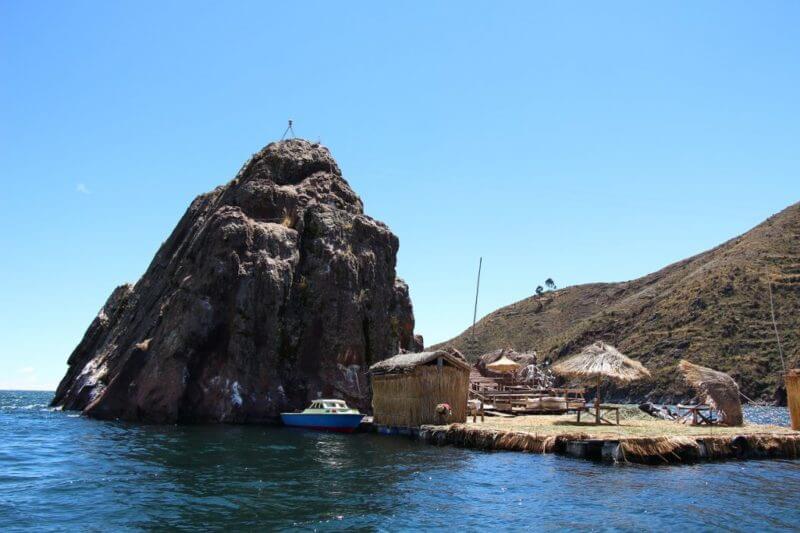
Lake Titicaca
This beautiful blue lake is an enormous body of water, unlike few others in the world. Watching the sunrise and sunset over this magnificent lake is priceless! Incredibly beautiful!
Lake Titicaca is the highest lake in the world upon which large vessels sail. In a northwest-southeast direction, it is about 190 kilometers long with a maximum width of 80 kilometers. It has an area of 8,562 km². 56% of this area (4,772 km²) belongs to Peru (Lake Titicaca Peru) and 44% (3,790 km²) to neighboring Bolivia. Its coastline spans 1,125 km. The maximum depth of the lake is estimated at 281 m, and its average depth is calculated at 107 m.
To think that you are sailing on the highest lake in the world is an inexplicable experience. A truly beautiful landscape, a lake with wonderful colors, a starry sky, shooting stars. UNMISSABLE!!!
Origin of Lake Titicaca
This lake formed from the drying of Lake Ballivián, which extended to Lake Poopó in Bolivia. In the high snow-capped peaks (some over 6,400 masl) of the central Andes, almost all of the twenty-five rivers that feed Lake Titicaca originate. Due to the altitude, the climate is very cold, and those not from the region must contend with altitude sickness.
What Altitude Is Lake Titicaca in Peru Located At?
This body of water, located on the Collao plateau, sits at an average altitude of 3,810 masl between the territories of Bolivia and Peru.
>>Also of interest: Humantay Lagoon in CuscoWhere Is Lake Titicaca Located?
Lake Titicaca is geographically located in the Andean mountain ranges (South America) in a basin of approximately 58,000 km². It is the highest navigable lake in the world and ranks nineteenth in the world by surface area.
The lake consists of two bodies of water separated by the Strait of Tiquina; the larger body of water is situated in the north and is called Lago Mayor or Chucuito. It has a surface area of 6,450 km², in which the greatest depth of the lake is found (283 m), very close to Soto Island. The smaller body, called Huiñamarca, is located in the south. It has an area of 2,112 km², with a maximum depth of 45 meters.
Legend of Lake Titicaca
A local legend says that after the great flood, it was at Lake Titicaca where the first rays of the Sun were seen.
According to legend, long ago, Lake Titicaca was a fertile valley where humans lived happily and peacefully. There was neither death, nor hatred, nor greed. The earth provided everything they sought; they lacked nothing because the mountain gods (the Apus) protected them. They forbade only one thing: climbing to the summit of the mountains where the Sacred Fire burned.
For a long time, humans never thought of breaking this divine law. But an evil spirit condemned to live in darkness could not bear to see the peace and happiness of humans. So he devised a way to sow discord among them. He challenged them to prove their courage by climbing to the top of the mountains to seek the Sacred Fire.
Faced with that challenge, one fine day, the men began climbing to the peaks of the mountains; but halfway up, they were surprised by the Apus. Seeing that the men had disobeyed, they decided to destroy them. As punishment, thousands of pumas emerged from caves and devoured the men, who begged the devil for help. But this evil spirit remained deaf to their pleas.
Seeing this, Inti, the Sun god, began to weep profusely. His tears were so abundant that they flooded the valley for forty days. Only a man and a woman managed to save themselves in a reed boat. When the sun shone again, the man and woman could not believe their eyes: under a clear blue sky, they found themselves in the middle of an immense lake. And everywhere floated the drowned pumas, transformed into stone statues.
That is why they named the lake “Titicaca”, which means the lake of stone pumas.
The Uros of Lake Titicaca
The inhabitants of the islands are not strictly Uros, but rather of Aymara origin. The last Uro known passed away in the 1950s. The Uros used to call themselves Kot-suña (‘people of the lake’), and it is possible that their ancestors were the Arawaks, the oldest people of the Americas. The current occupants—who live gathered around the community of Uros-Chullini—preserve very well the customs and way of life of their predecessors. That is why they call themselves by that name.
The territory includes 40 islands with an average of 50 people on each. The houses are single-room dwellings. Cooking is done outdoors to prevent fires. The people here sustain themselves through fishing, harvesting totora reeds, and tourism. To visit them, you must take a boat from the Puno pier.
The Floating Islands of Lake Titicaca
Lake Titicaca has numerous islands. But only some of them are floating mats made from dried totora reeds. This plant is a species of reed (cattail) that grows in the shallower parts of the lake; up to two meters high and highly water-resistant. These constructions are anchored firmly to the lake bed. They come in different sizes, some as small as a tennis court.
Totora grows from the bottom of the lake and rises one to two meters above the surface. To build these islands, the totora stalks are woven and bent, without breaking, until a straw foundation or floor is created that floats on the surface of the water. It is then covered with mud and reinforced with cut totora stalks. The locals live upon these floating vegetative structures in cabins built from the same totora reed.
Once a year, the islanders renew the top layer of reeds on the platform to compensate for the wear and tear of the bottom layer. The thickness of the platform is approximately 1.8 meters, and the bottom layer gradually rots away.
The Encyclopædia Britannica states that these islands have been inhabited for a very long time, adding: “Those who inhabit the lake make their famous rafts from bundles of dried totora tied together, giving them an appearance reminiscent of the crescent-shaped papyrus vessels depicted on ancient Egyptian monuments.”
How to Get to Lake Titicaca from Cusco
There are three ways to do it:
1) The Most Expensive (by Train)
The journey is wonderful and unforgettable, but expensive, around 220 to precios varían (consulta la web oficial)
2) Intermediate Cost (Tourist Bus)
Tourist buses make stops for photos and visits at places of interest. They also stop at designated places for meals. The journey takes approximately 11 to 12 hours. The cost ranges from 50 to precios varían (consulta la web oficial), depending on the company.
3) The Economical Option (Direct Bus)
They are easy to find, as almost all are located at the Terminal Terrestre in Cusco. You can choose between prices and bus quality. Several schedules are available, and the travel time is 7 hours. The most recommended and most expensive bus, of course, is Cruz del Sur (prices from 20 to precios varían (consulta la web oficial)). Besides this, there are others with varying prices and quality, from 8 up to precios varían (consulta la web oficial). Tickets are purchased right at the terminal, and to make a good choice you will want to inspect them inside and out.
How to get to the Cusco bus terminal by car
How to get to Lake Titicaca from Cusco by car
Photos of Lake Titicaca
/06/Lago-titicaca-peru-2.jpg)
/06/Lago-titicaca-peru-1.jpg)
/06/Lago-titicaca-peru.jpg)
/06/habitantes-indigenas.jpg)
/06/lago-titicaca-isla-taquile.jpg)
/06/lago-titicaca-peru-chozas.jpg)
Featured Image CC0 by licenerenck
Your Experience When Booking: “From Puno: Tour to the Uros and Taquile Islands”
What you’ll do
- Marvel at the floating islands built by the Uros
- Enjoy the splendor of Lake Titicaca
- Taste the local food
- Meet and interact with the indigenous people and learn more about their life on the lake