Location of Cusco
It is located in a fertile valley bathed by the waters of the Huatanay and Tullumayo rivers, surrounded by hills and mountains; in the southern highlands of Peru, at 3,399 masl. Few places in the world can offer us such diverse and unforgettable experiences. As soon as you arrive in the city, you find yourself wrapped in a kind of journey to the past. Its imposing structures such as Sacsayhuamán, with massive stones 9 meters high and weighing 350 tons; ceremonial centers like Qenqo and Tambomachay make the trip a fabulous experience.
The city of Cusco covers 617,000 km2. The Inca city stands on what was once (100,000 years ago) a lake bed, which according to researchers was occupied by Lake Morkill. The distance from Lima to Cusco is 1,089 km.
Why It Is Called the “Navel of the World”
“Navel of the world”? Cusco (“Q’usqu”) means “navel of the world” in Quechua. Cusco was the capital of the Inca Empire, and for them it was the navel of life. Thus, the known world consisted of the four regions of the Tahuantinsuyo. All roads led to or departed from this Inca capital in the center of the Andes.
Tourist Attractions of the City
City Attractions
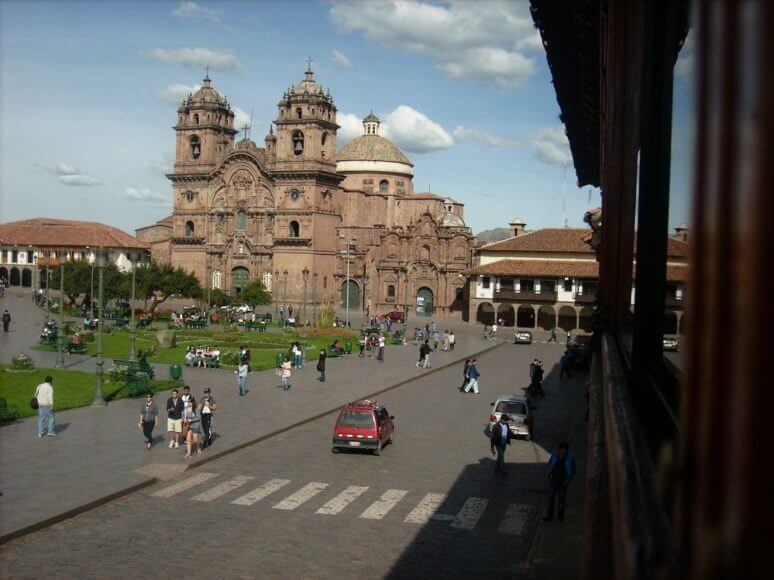
Plaza de Armas
Also called Aucaypata (‘warrior’s square’) or Huacaypata (‘square of laments’), it is believed to have been designed by Manco Cápac, the mythical founder of the Tahuantinsuyo. During the Inca era, this square was twice its current size and was divided by the Huatanay River; in the center there was a fountain, and all the main Inca ceremonies took place in this plaza. In its surroundings, Pachacútec, Sinchi Roca, Viracocha, Túpac Yupanqui, and Huayna Cápac built their palaces.
During the Spanish conquest, the churches that surround the Plaza today were built over these structures, such as the Cathedral, the Church of El Triunfo, Sagrados Corazones, and La Compañía. Diego de Almagro, conquistador and rival of Francisco Pizarro, was executed in this plaza in 1538; his son, Diego de Almagro “El Mozo”, in 1542; Túpac Amaru I, the last rebel Inca, in 1572; and Túpac Amaru II, precursor of independence, in 1781.
>>Also of interest: The Sacred Valley of the Incas, a beautiful excursionSan Blas Neighborhood
/04/barrio-san-blas.jpg)
It is the most picturesque neighborhood in Cusco. It is the “artisans’ neighborhood”, as it is home to the most popular artists of the region. Here, houses have become workshops, schools, and shops producing all kinds of crafts, made in a unique style that has become known worldwide.
Under the layout of colonial Cusco, this neighborhood became the mestizo area of the city, where hundreds of Spaniards lived alongside the natives. This coexistence and the whimsical geography of the area gave rise to the peculiar architecture of San Blas, with its narrow streets on twisting slopes where modest adobe houses feature doors, windows, and balconies painted in blue.
The streets of San Blas offer small surprises to the curious traveler. For instance, on Siete Angelitos street you will find a cornice with seven cherubs looking up to the sky; on Siete Diablitos street you will also find seven little devils. If you head along Tandapata, Chihuanpata, and Suytucato streets, you will find country estates and traditional picanterías. In the main square, you will see the oldest church in the city of Cusco.
Hatun Rumiyoc Street
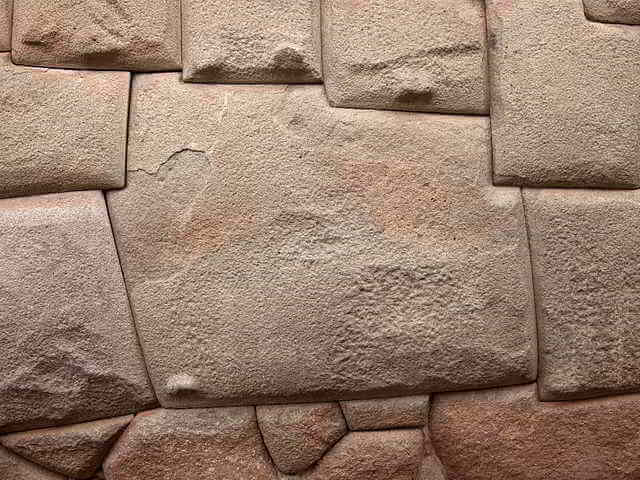
Located on Calle del Triunfo two blocks from the Plaza de Armas as you walk towards the San Blas neighborhood. This street is famous because its impressive stone wall preserves the Twelve-Angled Stone (on the right side). This wall was once part of the palace of the panaca of Inca Roca, the sixth ruler of the Cusco empire.
Plaza Nazarenas
Located three blocks from the Plaza de Armas via Calle Almirante. This colonial construction was part of the Yachaywasi (‘house of learning’). Today it is surrounded by colonial buildings erected on Inca foundations. Notable among these buildings are the novitiate and the first site of San Antonio Abad University (now the Hotel Monasterio), next to which stands the Church of San Antonio Abad. The convent and Church of Las Nazarenas also stand out.
Pukamarka or Puca Marka
It was the family palace of Inca Túpac Yupanqui, who ruled from 1471 to 1493. It is estimated to have covered the present-day streets of Maruri, San Agustín, Santa Catalina, and Arequipa. Long sections of its walls are currently preserved along Maruri and San Agustín streets.
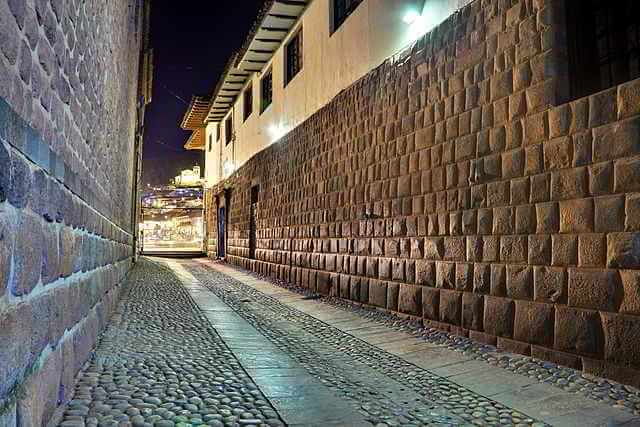
Loreto Street
Also known as Intik’ijllu (‘sun street’). It is located off the Plaza de Armas on one side of the Church of La Compañía. This passageway features the best-preserved and probably the longest Inca walls in the city of Cusco. On one side are the walls of the Jesuit Church, and opposite them are those of Amarucancha, palace of Huayna Cápac, the penultimate Inca emperor. The street ends at a curved corner that formed part of the Acllahuasi, or ‘house of the chosen women of the sun’.
/04/calle-en-cusco-ciudad.jpg)
Qolqampata
Located on the slopes of Sacsayhuamán. According to tradition, these remains are believed to have belonged to the palace of Manco Cápac, the first Inca of the Tahuantinsuyo. The exterior wall of this palace features 10 large niches, said to represent the ten founding ayllus of the empire. In reality, these remains show structures from different periods.
Churches and Convents
The Cathedral, Church of El Triunfo, Church of Sagrados Corazones or Sagrada Familia, La Compañía de Jesús, La Merced, Santo Domingo, Santa Catalina, San Blas, San Francisco, San Pedro, San Cristóbal
Mansions and Museums
Archbishop’s Palace or Museum of Religious Art, Casa Garcilaso de la Vega or Regional Historical Museum, Santa Catalina Museum, Casa Cabrera, Admiral’s Palace or Inca Museum, House of the Serpents, House of the Marquis of Valleumbroso, Casa Concha
Map of museums in the city of Cusco
Photo CC by renzonapa
Your Experience When Booking: “Cusco: Half-Day Tour”
What you’ll do
- Behold stunning destinations and examples of Inca stonemasons’ engineering masterpieces
- Begin the tour with a visit to Cusco Cathedral, built in 1560
- Visit numerous ancient temples and sites where civilization began