<small><small><small>Foto CC por </small></small></small><small><small><a href="http://www.flickr.com/photos/pratiproy" target="_blank" rel="noopener">pratiproy</a></small></small>
The Sacred Valley of the Incas
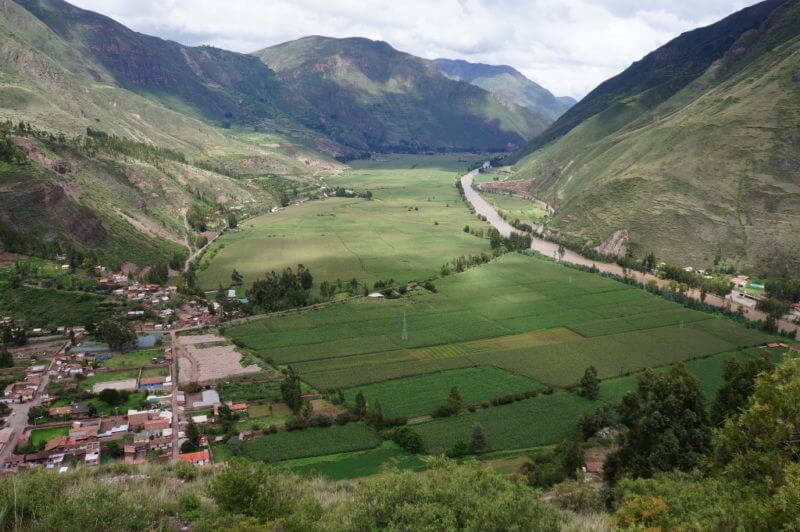
The Sacred Valley of the Incas graces visitors with a serene natural landscape. Down the slopes of towering Andean peaks cascade harmonious Inca agricultural terraces. Under the majestic blue sky stretches a necklace of picturesque traditional villages such as Pisac, Yucay, and Ollantaytambo, each framed by remarkable Inca ruins and sacred sanctuaries.
In the Inca era, the valley served as the agricultural and spiritual heartland of the empire. Today, it forms the premier gateway route to Machu Picchu. With its pleasant warm climate, stunning vistas, and charming colonial towns, the Sacred Valley of the Incas welcomes you to experience an unforgettable journey.
Distance from Cusco
60 km traveling via the northern route through Chinchero, or 70 km approaching from the south via Pisac.
Altitude
Situated in the Peruvian Andes at an average elevation of 2,850 meters above sea level (masl).
Temperature
Max: 17°C (63°F) | Min: 2°C (36°F) | Average: 11°C (52°F).
A Breathtaking Excursion
To truly appreciate Inca civilization, you need to immerse yourself in their sacred landscape—which makes this excursion truly extraordinary. You will visit world-renowned archaeological complexes of profound historical significance: high-altitude mountaintop citadels, ceremonial sun temples, and engineered agricultural terraces. The scenery is magnificent: throughout the valley, emerald crop fields spread out below, tended by local farmers in vibrant traditional dress. Seen from high mountain roads above, the geometric patchwork of fields, ancient terraces, and the rushing Vilcanota (Urubamba) River create an unforgettable panoramic spectacle. It is a rewarding tour through an enchanting valley.
The Sacred Valley of the Incas comprises the fertile alluvial river basin connected by the Urubamba River, extending from Pisac to Ollantaytambo. These two anchor destinations feature the most magnificent archaeological complexes in the region, serving as the grand prelude to Machu Picchu.
>>You may also be interested in: Humantay Lagoon, an Incredible DreamWhy It Is Called the Sacred Valley
According to Andean cosmology, the Incas revered this valley as sacred because the winding Urubamba River mirrored the celestial Milky Way (the cosmic river Mayu). For this reason, numerous sanctuaries and sun shrines were erected along the valley floor and mountain crests for celestial worship and precise astronomical observation.
While much of the ancient Inca astronomical lore was lost during the conquest, surviving oral traditions and chronicles show that the Incas categorized constellations into two types: luminous constellations formed by bright star clusters, and dark cloud constellations (Yana Phuyu) traced within the dark interstellar dust lanes of the Milky Way. These celestial shapes corresponded to animals of the Andean world, including the celestial Llama (Yacana), the Condor, and the Serpent.
This valley was also the cradle of foundational legends regarding the divine origins of the Inca rulers. Its exceptionally fertile microclimates produced the prized giant white corn (Paraqay sara) and native potatoes that nourished the imperial nobility of Cusco. Even today, many of these multi-tiered Inca terraces remain actively cultivated by local Quechua communities.
/08/Ruinas-Valle-Sagrado.jpg)
When to Visit
From November to April, the Andean rainy season brings frequent afternoon downpours. Visiting the Sacred Valley during the dry season (May to October) offers sunny days, crisp clear blue skies, and optimal conditions for trekking and photography.
Itinerary
The Sacred Valley encompasses rivers, sweeping mountain vistas, monumental archaeological ruins, and traditional villages that preserve ancient Quechua heritage. You will also discover natural hot springs and thrilling outdoor adventures, including river rafting, rock climbing, paragliding, horseback riding, and alpine trekking.
In addition, you can savor refined Andean gastronomy and enjoy tranquil nights under star-filled skies.
Pisac is the scenic gateway to the valley, crowned by a massive Inca mountain fortress. In town, as well as in Chinchero, you will find Cusco’s most celebrated traditional artisan and textile markets. In Calca, you can hike to Huchuy Qosqo (“Little Cusco”), an elevated Inca palace where Emperor Viracocha spent his final days.
You cannot miss the concentric sunken agricultural terraces of Moray and the ancient multi-tiered salt pans of Maras. Urubamba is the commercial heart of the Sacred Valley, offering a tranquil, temperate climate, lovely colonial churches, and scenic landscapes that make it an ideal base.
Pisac
Located in the Yucay Valley along the right bank of the Urubamba River. Its name is associated with the Andean partridge (p’isaqa). The monumental complex of Pisac features masterclass imperial Inca stonework, ceremonial baths, and sweeping agricultural terraces.
Calca
This peaceful town of Inca origin is framed by two snow-capped peaks (Sahuasiray and Pitusiray). Due to its strategic central location, Calca serves as a vital commercial hub in the Urubamba valley.
Yucay
A picturesque, sunny Inca settlement with a delightful microclimate. Here in Yucay you will admire some of the most beautifully preserved and fertile agricultural terracing in the Andes.
Urubamba
Meaning “plain of a day’s journey” in Quechua, Urubamba is the geographic center of the Sacred Valley. It boasts lively traditional picanterías and countryside restaurants, luxury eco-lodges, boutique hotels, and rustic retreats.
Ollantaytambo
According to historical chronicles, Inca Emperor Pachacuti and later Viracocha oversaw the monumental construction of Ollantaytambo. Meaning “the resting place of Ollanta,” it commemorates the legendary Inca general Ollanta who conquered the northern coast before embarking on a forbidden romance with a royal princess. Today, it remains the only living Inca town with original street layouts and canals.
Chinchero
Chinchero was a grand royal estate, religious sanctuary, and administrative hub constructed by Emperor Túpac Inca Yupanqui along the historic Inca road to Machu Picchu. Today, it is world-renowned for its master indigenous weavers and fine alpaca textiles.
Moray
Moray features astonishing concentric amphitheater-like agricultural terraces. The Incas masterfully utilized these bowl-shaped depressions as an agricultural research center, taking advantage of temperature variations up to 15°C across different terrace levels to domesticate crops.
Maras
Maras is world-famous for its thousands of tiered pink salt evaporation ponds, sustainably hand-harvested by local families since pre-Inca times. It is a must-visit wonder for photographers and gourmets alike.
Zurite
An authentic Andean village with cobblestone streets where in Zurite you will discover the most extensive single complex of Inca agricultural terraces in Peru, spanning over 11 hectares of rich farmland. It is a fantastic off-the-beaten-path excursion taking around 4 hours from Cusco.
Huarocondo
Huarocondo is celebrated across Peru for its traditional roasted suckling pig (lechón al horno). It is a charming rural town located 1 hour west of Cusco.
/08/ruinas-ollantaytambo.jpg)
Access Routes
The Sacred Valley can be reached via two main paved highways:
- From Cusco north via Chinchero (28 km) down into the town of Urubamba (57 km total).
- From Cusco northeast through Pisac (30 km), following the scenic course of the Urubamba River down to Calca (48 km).
Where to Catch Transportation
- Cusco-Urubamba via Chinchero: Terminals along Av. Grau s/n. Minivans and buses depart every 30 minutes between 5:30 am and 5:00 pm.
- Cusco-Urubamba via Pisac: Terminals along Av. Tullumayo s/n. Minivans and buses depart every 30 minutes between 5:30 am and 5:00 pm.
See Av. Tullumayo Bus Stop Map
See Sacred Valley Location Map
Where to Stay in the Sacred Valley
Pisac
Royal Inka
Carretera Pisac-Ruinas, km 1.5
084203064
www.royalinkahotel.com
Yucay
La Casona de Yucay
Plaza Manco II 104
084201116
www.hotelcasonayucay.com
Sonesta Posadas del Inca
Plaza Manco II 123
084201107
www.sonesta.com/sacredvalley
Urubamba
Casa de Campo Urubamba
Carretera Pumahuanca
084244404
www.hotelcasadecampourubamba.com
Sol y Luna
Fundo Huincho, Lote A5, Carretera principal Ollantaytambo, Urubamba
084201620
www.hotelsolyluna.com
Casa Andina Private Collection Valle Sagrado
Quinto paradero, Yanahuara
984765501
Ollantaytambo
Hotel Munay Tika
Av. Ferrocarril 118
084204111
www.munaytika.com
Hostal Sauce
Ventiderio 248
084204044
www.hostalsauce.com.pe
Pakaritampu
Av. Ferrocarril s/n
084204020
www.pakaritampu.com
See Map with Accommodation Information
Where to Eat in the Sacred Valley
Pisac
Restaurante Valle Sagrado
Amazonas 116
084203009/084436915
Urubamba
Tres Keros
Av. Señor de Torrechayoc s/n
084201701
Tunupa Valle
Carretera Cusco-Ollantaytambo km 77
Fundo Tarabamba
084201471/084252936
Restaurante Killa Wasi
Fundo Huincho, Lote A5, Carretera principal Ollantaytambo Urubamba
084201620
www.hotelsolyluna.com
Wayra
Fundo Huincho, Lote A5, Carretera principal Ollantaytambo Urubamba
084201620
www.hotelsolyluna.com
Ollantaytambo
Mijuna Wasi
Av. Ferrocarril s/n
084204020
www.pakaritampu.com
Yucay
Don Manuel
Av. San Martín 104, Plaza Manco II
084201116
www.hotelcasonayucay.com
Inkafé restaurant
Plaza Manco II s/n
084201107
Foto CC por: pratiproy
Your experience when booking: “From Cusco: Full-Day Private Sacred Valley Tour”
What you will do
- A private tour of the Sacred Valley of the Incas, visiting magnificent temples and agricultural terraces.
- Learn about ancient Inca culture, customs, and astronomy with a knowledgeable guide.
- Enjoy a flexible private tour that allows you to set your own pace at each archaeological site.