Origin and Location
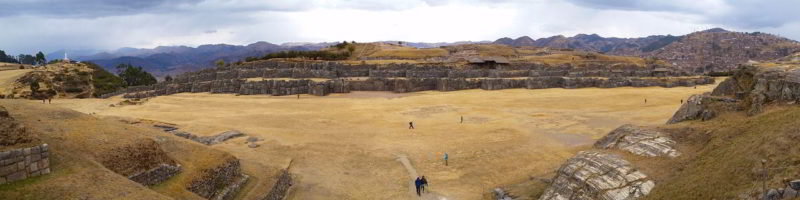
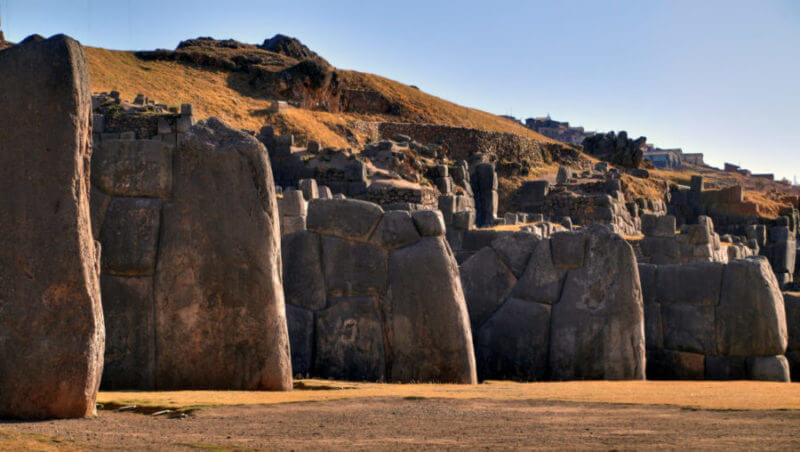
Sacsayhuamán is located 2 km north of the city of Cusco, at an altitude of 3,600 meters above sea level (masl). This impressive construction was designed by Inca Túpac Yupanqui at the end of the 14th century and the beginning of the 15th century. It is estimated that it took 60 years to finish and required the labor of 20,000 men. The architectural complex is composed of extensive carved stone walls that rise across three levels, forming three superimposed platforms, each crowned by a zigzag wall.
/12/cusco-sacsayhuaman.jpg)
The Function of Sacsayhuamán
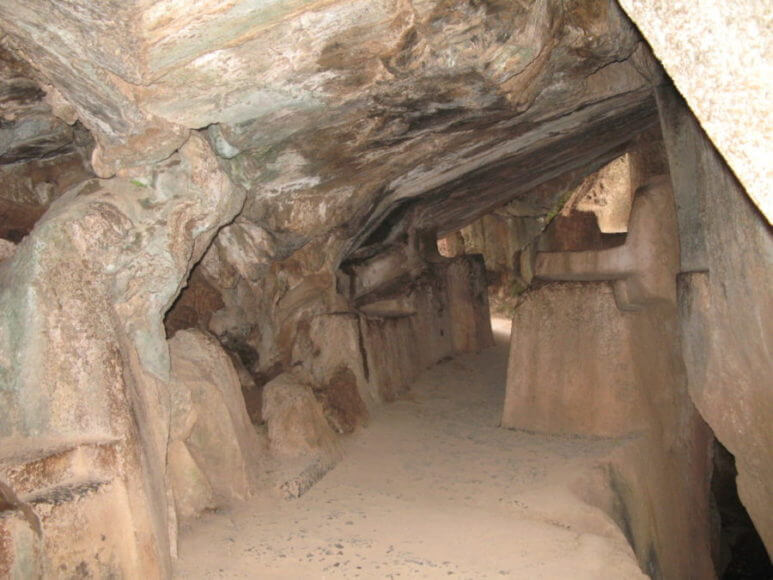
In Spanish/English, Sacsayhuamán—or Saqsaywamán—means ‘satisfied hawk’ or ‘proud hawk’. There are several hypotheses about the purpose of this construction. One points to its function as an Inca fortress. Another indicates that it was a shrine dedicated to the god Illapa (lightning). On the other hand, according to Cieza de León, it was the Royal House of the Sun, the supreme deity of the Incas. However, archaeologist Pablo de la Vera asserts that it was “a ceremonial center dedicated to the worship of elements such as the Sun and water.” This theory has been reinforced by the recent discovery of a natural spring that supplies a network of ceremonial channels distributing water toward the four cardinal points.
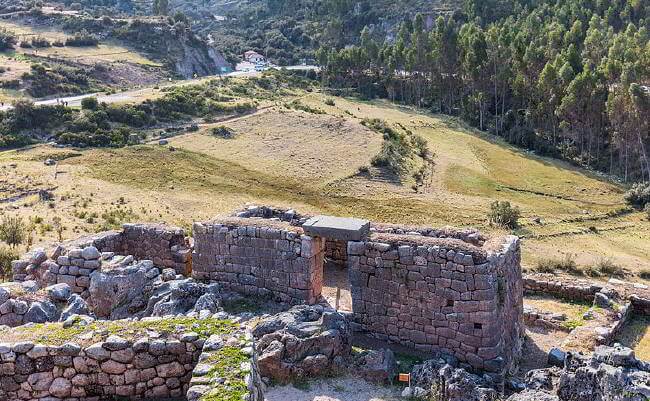
The architectural complex comprises various passageways, enclosures, stairways, and the foundations of three large towers on the upper level. In the Chuquipampa (‘courtyard of lances’) or main courtyard, religious ceremonies were held. Here, the ñustas paid homage to the Sun at every sunrise. The site is completed by the Muyuqmarka, or ‘solar calendar’, the Inca’s Throne, the Rodadero or Suchuna (a kind of natural stone slide), and the “tired stone” or Saykuska.
>>You may also be interested in: The Sacred Valley of the IncasWhy Does It Have a Zigzag Shape?
Sacsayhuaman, built between the 14th and 15th centuries, features both architectural and natural components. It was built in a zigzag pattern. Some say it represents the teeth of a puma, while others claim it represented lightning, one of the Inca deities. Still others say the Incas wanted to mimic the movement of a serpent. When viewed from above, the construction has the shape of a lightning bolt, though it is not known with certainty whether this hypothesis is true. What we do know is that in these ruins we will see walls with enormous stones and appreciate the exceptional construction quality of this civilization. Monumental stones, carved and rounded with a quality that continues to inspire admiration to this day.
An Unmissable Wonder in Cusco
Sacsayhuamán is a fascinating place with vast acreage to explore and natural stone slides (Rodadero), all surrounded by one of the most breathtaking Inca archaeological sites in existence. A must-visit and best of all, very close to Cusco.
The ceremonial construction and fortress of Sacsayhuamán is located 2 km from Cusco, just a few minutes away by taxi. It is a monumental construction that takes your breath away and astounds by its scale. It can be reached on foot; the distance is not great, but it is only recommended for people in good physical condition, as it is located at 3,600 masl. It spans a large area, and the valley is surrounded by mountains. It is a landscape of tremendous beauty, where llamas and falcons can often be seen.
Don’t forget to wear comfortable shoes and walk slowly; the altitude and the urge to take photos in every corner can quickly drain your stamina.
Entrance Tickets
Admission to Sacsayhuamán varies (check the official website). You can also purchase the full tourist ticket for prices vary (check official website) (just over prices vary (check official website)), which allows you to visit not only Sacsayhuamán but also other sites such as Q’enqo, Puka Pukara, and Tambomachay. It is truly worth visiting these places. The visit takes approximately 4 hours. It is well worth doing.
How to Get There on Your Own
This archaeological complex is located north of Cusco’s main square, 2 km from the city, and can be reached in three ways:
By Local Bus
There are two transport companies that can take you. The first is “El Señor del Huerto”. To catch this bus, go to the Colegio Garcilaso de la Vega stop. Then get off at Cristo Blanco (the statue) and walk from there to the entrance of the ruins. The bus fare is 1 sol. Below is a walking map to reach that point from the Plaza de Armas.
How to get to the Colegio Garcilaso de la Vega bus stop from the Plaza de Armas
The second option is the transport company “El Cristo Blanco”. Take the bus at a stop between Calle Puente Rosario and Av. El Sol (see the map below). Get off at Cristo Blanco (the statue) and walk from there to the entrance of the ruins. The bus fare is 1 sol.
How to get to Calle Puente Rosario from the Plaza de Armas
/05/paradero-calle-puente-rosario-y-av-el-sol.jpg)
On Foot
You can also walk up via the narrow street next to the Cathedral. The climb is steep and takes about 30 minutes from the Plaza de Armas. You should be in good physical condition, because the entire route is uphill. Also remember to save enough energy to explore the ruins.
By Taxi
You can hire a taxi for 8 to prices vary (check official website) to take you to the top. After your tour, you can easily walk down to the San Blas neighborhood.
How to get to Sacsayhuamán by car
Your Experience When Booking: “Cusco: Historic Guided Tour with 4 Inca Ruins”
What you will do
-See the impressive Inca archaeological sites of Sacsayhuamán, Q’enqo, Puka Pukara, and Tambomachay
-Explore the Temple of the Sun and the famous Cathedral of Cusco
-Discover the history of the Inca Empire with an expert guide