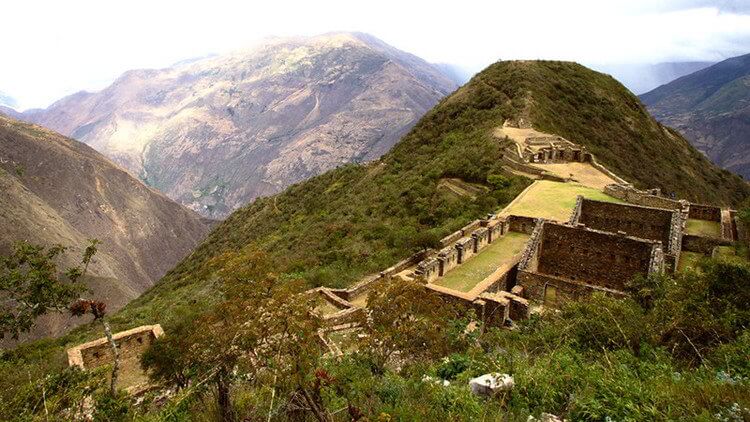
Choquequirao (“Cradle of Gold”) is just as marvelous as Machu Picchu, yet far less visited. Choquequirao is also known as the sister city of Machu Picchu. It is a vast archaeological complex featuring finely cut stone buildings arranged according to Inca dualism, divided into a lower sector (“Urin”) and an upper sector (“Hanan”).
Origin
The Incas built Choquequirao—meaning “Cradle of Gold” in Quechua—at the dawn of the 16th century, when their fierce resistance against Spanish conquistadors compelled them to take refuge in the remote, inaccessible valleys of the high Amazonian cloud forest.
Altitude
This archaeological complex is situated on the mountain of the same name, at an elevation of 3,104 meters above sea level (masl).
Climate
The climate is temperate, with warm sub-tropical influences due to its proximity to the deep Apurímac River Canyon. The average temperature is 16°C (61°F).
Location
This sprawling citadel is reached via a 1.5-day trek from the town of Cachora, located 35 km northeast of Abancay along an unpaved road. The ruins of the Inca city are perched upon the western spurs of Mount Salkantay, in the district of Santa Teresa, Province of La Convención, Department of Cusco, in southern Peru.
Archaeological Monuments
Among its principal architectural features are the renowned “Triumphal Wall,” the ceremonial hill or ushnu, several prominent kallankas (large ceremonial hall buildings), and beautifully preserved stone terraces in excellent condition.
>>You may also be interested in: Inca Trail to Machu PicchuHow to get there
Reaching Choquequirao across its rugged mountainous terrain currently takes between 10 and 12 hours of trekking, depending on your hiking pace and rest intervals.
There are three main routes you can take to reach the ruins:
From Cachora
This trekking route takes about 10 hours.
You begin by traveling from Cusco toward the province of Anta, then cross the Apurímac River toward the province of Abancay to reach the town of Cachora or the district of Huanipaca. Next, continue 8 kilometers by vehicle to the Capuliyoc viewpoint perched on the mountainside. From Capuliyoc, a hike of approximately 4 hours (covering over 10 km and a 1,400-meter descent) leads down to Playa Rosalina, located on the left bank of the Apurímac River.
At Playa Rosalina, you can set up camp to spend the night securely, as a registered control post run by the Cusco Directorate of Culture is located here.
The following morning, set out at daybreak, cross the suspension bridge over the Apurímac River to the right bank, and commence the steep ascent toward Choquequirao. After three hours of climbing, you will reach the small settlement of Santa Rosa for a rest, before continuing for another two hours up to the village of Marampata. The trail is steep and the weather is warm, covering a strenuous 1,400-meter ascent. In Marampata, you will find restrooms, potable water, and solar-powered facilities. Early the next morning, make the final trek to the ceremonial center by following the marked arrows. From here, the path levels out, skirting the mountain from east to west. After about an hour of walking, you will arrive at majestic Choquequirao.
From Huanipaca
10 hours
Travelers choosing this route save considerable travel time and enjoy an intense workout. Traveling ultralight is strongly recommended: bring only essentials, including a water bottle, water purification tablets, tent, sleeping bag, and quality trekking apparel. Pack canned food, biscuits, granola, instant soups, and a compact camp stove or small kerosene bottle for cooking.
From Cusco, it is a 4-hour drive to the Huanipaca junction. A Cusco-Abancay bus (fares vary, check official website) will drop you at this junction. From the junction, wait for local transport into Huanipaca, which may take between one and several hours depending on vehicle availability.
Local transport brings you to Huanipaca in about 1 to 1.5 hours. The hike begins from this small town. It takes 2 brisk hours to reach the community of Tambobamba, followed by a 4 to 5 hour descent to the Apurímac River. If you started in the morning, this riverbank is an ideal campsite. Early the next morning—to avoid the scorching sun—tackle the rigorous 5-hour ascent toward the ruins. Once again, remember to pack light (Choquequirao has restroom facilities and fresh water), bringing only your tent and sleeping bag, as spending at least one night exploring this vast site is essential after the climb.
For the return trip, maintaining a steady hiking pace allows you to reach Huanipaca in one day. We recommend descending from the ruins down to the river around 4:00 pm, reaching the campsite near sunset after two hours of walking. Camp by the river once more, and the next day, a consistent hike brings you back to Huanipaca before nightfall—exhausted but thrilled.
From Santa Teresa
12 hours
First, travel to Machu Picchu and then descend to the district of Santa Teresa. From there, drive along an unpaved road through several small villages to reach Yanama, about 3 hours by vehicle from Santa Teresa. From Yanama, hike up and over Mount “San Juan” and descend to the hamlet of Maizal, which sits directly opposite Choquequirao across the valley.
Challenging, but well worth it
The arduous journey is part of what makes this trek truly magical. It is an extraordinary place to discover and appreciate, far from mass tourism and intimately connected with nature. Along the route, you will encounter designated campsites to pitch your tent and spend the night, with opportunities to purchase drinks, snacks, and basic supplies. It is a demanding trek: you descend from 3,500 masl down to 1,500 masl and climb back up again. But when you finally arrive, the scenery is breathtakingly spectacular. Every single step is rewarded. The panoramic views are awe-inspiring and the ancient citadel is simply unforgettable.
CC Photo by MI PERÚ
Your experience when booking: “4-Day Trekking Route through Choquequirao”
Discover the ruins of Choquequirao and other inland landscapes of Peru with this trekking route that traverses beautiful Andean villages over 4 days.
Don’t make it complicated!! BOOK NOW!!